Prepare approved answers for the first call
A clear first response begins with facts your business can approve and a boundary around what is not yet known.
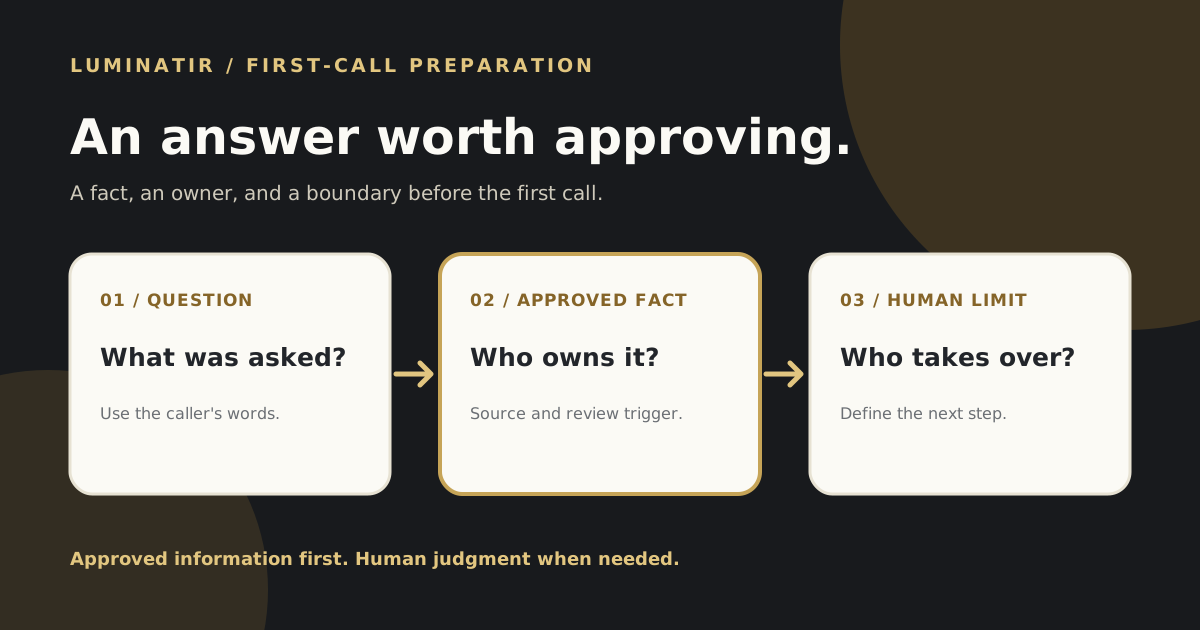
Before an inbound phone agent answers a common question, decide what your business actually wants it to say. A useful answer has a verified source, a clear scope, and a next step for the question it cannot resolve. You do not need to script every conversation; you do need to know which facts are safe to present as routine information.
Luminatir's first-call flow is shaped around the questions, approved answers, routes, and handoffs your business defines. This worksheet is for preparing that business input. It is not a depiction of a platform screen or an automatic accuracy check.
Start with one question people really ask
Choose a specific question, not a broad category such as “pricing” or “availability.” Ask the person who normally answers it what the caller needs to know on the first call. If the answer depends on an estimate, a changing schedule, or an individual account, the approved response may be an explanation of the next step rather than a definitive answer.
For each candidate answer, identify four things:
- The fact: What can the business state without checking a live situation?
- The source: Where is the current wording kept, and who approves it?
- The limit: Which variation would make a general answer incomplete or misleading?
- The next step: Who should take over when the limit is reached?
If you cannot name the source and its owner, the wording is not ready to be treated as an approved answer. A concise answer that respects its limits is more useful than a polished sentence that guesses.
Separate stable facts from individual decisions
Published hours, a general service description, or an ordinary intake instruction can be candidates for a common answer when someone keeps them current. A custom quote, exception to policy, or account-specific question is different. The first-call flow should not turn a request for a decision into an invented decision.
Illustrative planning example: A caller asks whether a service is available for their particular situation. The business has approved general service wording, but the caller's details require individual review. The first response can explain the general information and say that a person will assess the specific request. This is not a real customer or a claim that any particular route is configured.
The human-handoff guide helps frame which conversations belong with a person. The first-call checklist connects that boundary to the wider caller experience.
Make one answer card before making many
Write one row per common question. Leave a cell blank if the business has not approved it yet; that blank is a setup question, not permission to improvise.
| Caller question | Approved answer or next-step wording | Fact owner and source | When a person takes over |
|---|---|---|---|
| What does the caller ask? | Use exact approved wording, or note that it is pending. | Name the responsible person and source. | Describe the exception and receiving role. |
Ask the fact owner when the answer should be reviewed: for example, when hours, services, staffing, or policy changes. Later, use a first-call experience review to check whether the answer and next step remain clear. The answer card is a buyer-owned planning tool, not a promise of automatic content monitoring.
Bring the boundary into the first-flow conversation
Bring your answer cards, unresolved exceptions, and desired human routes to a conversation with Luminatir. A sales agent can help establish the initial flow; later changes can be made in the platform, with support available if you need help. Confirm the actual configured path with the team before relying on it. The goal is a first response grounded in what your business knows, with a clear way to move beyond it when a person is needed.