How to Review the Quality of a First-Call Experience
A first-call experience should not sit uninspected once configured. Periodic qualitative reviews help teams spot stale greetings, confusing next steps, and broken handoff context.
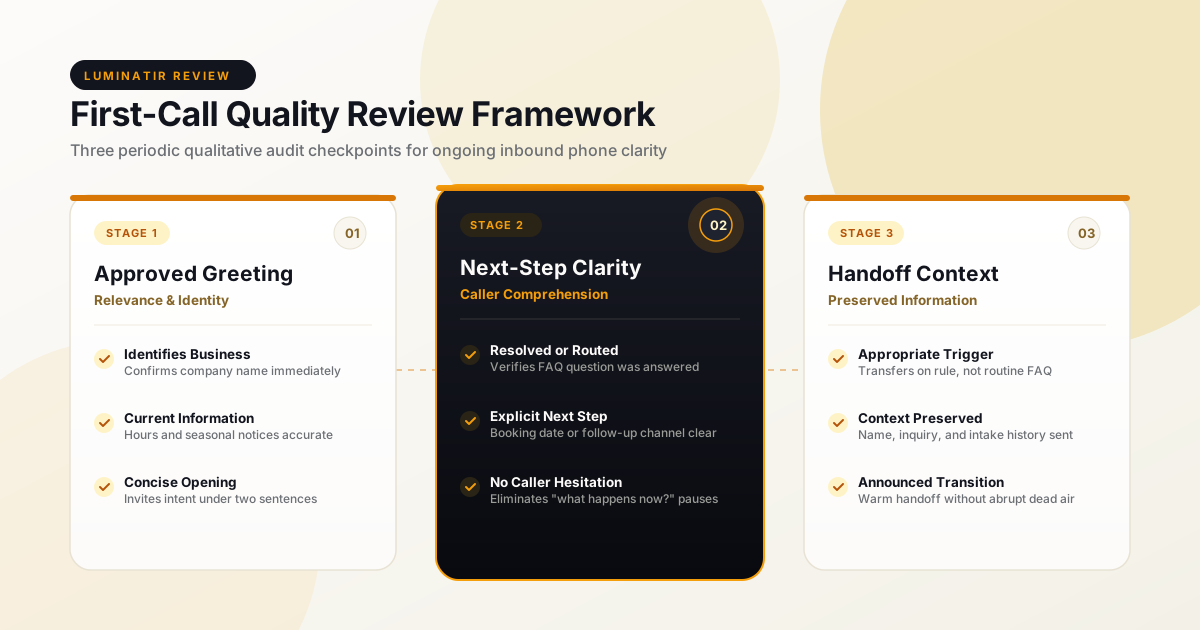
Configuring an inbound phone flow is a major milestone for any business. Once your business hours are set, approved answers are loaded, and routing paths are connected, it is tempting to consider the job finished.
However, business operations evolve constantly:
- Service menus change, pricing models adjust, and seasonal hours shift.
- Staff roles turn over, meaning a warm transfer routed to a specific extension or team member may reach an empty desk.
- Callers begin asking questions your initial configuration never anticipated.
When an inbound call flow sits uninspected for months, small disconnects accumulate. Callers receive outdated answers, endure awkward handoffs, or hang up unsure of what happens next.
The direct answer is that a business owner or service lead should conduct periodic qualitative reviews of their first-call experience using three concrete evaluation checkpoints: greeting relevance, next-step comprehension, and handoff context fidelity.
This does not require artificial scoring algorithms, fabricated quality metrics, or complex monitoring platforms. Quality in customer intake is fundamentally qualitative: does the conversation accurately represent your business, respect the caller's time, and leave both the caller and your team with absolute clarity?
1. What to listen and look for in an approved greeting
The greeting is the caller's initial window into your business. A well-designed opening sets immediate expectations, establishes a professional tone, and invites the caller to state their need without navigating rigid menus.
During a periodic review, evaluate your greeting against four qualitative questions:
- Does the greeting clearly identify the business? Callers dialing from search results or mobile directories need immediate confirmation that they reached the right company.
- Is operational information strictly current? Check that any mention of business hours, primary service areas, or active seasonal notices reflects reality today. Nothing erodes trust faster than a greeting citing holiday hours in mid-spring.
- Does the greeting invite natural intent rather than restrictive menus? A modern inbound flow allows callers to explain why they are calling in their own words. Avoid bloated introductory scripts that list every department before asking how to help.
- Is the tone concise and unhurried? Review whether the greeting feels welcoming and respectful. An opening that runs longer than two concise sentences risks frustrating callers who have an urgent inquiry.
When conducting this check, perform a live test call into your line. Listen as if you were a first-time customer who knows nothing about your internal department structure. If the opening feels cluttered or stale, update the approved greeting in your platform.
2. Testing whether the caller understands the next step
An inbound conversation should never end on vague assurances. Whether an agent answers a common question, captures intake details, or schedules an appointment, the conversation must conclude with a clear, unambiguous next step.
When reviewing sample call interactions or testing common caller scenarios, assess whether the conversation provides immediate clarity:
- For common inquiries and FAQs: When an answer is provided—such as pricing policies, service availability, or location details—does the agent confirm whether that resolved the caller's question before moving forward?
- For appointment requests and scheduling: Does the caller clearly understand whether an appointment is tentatively requested or confirmed? Do they know how confirmation details will arrive (such as via SMS or email) and what preparation is required?
- For message intake and callbacks: Does the caller know who will follow up, through which channel, and within what expected timeframe? An interaction that ends with “someone will get back to you” leaves callers wondering whether their message disappeared into a void.
Identifying caller hesitation
During review, pay close attention to signs of confusion:
- Does the caller ask, “So what happens now?” or “Should I call back later?”
- Are there awkward pauses where the caller seems unsure whether the interaction is over?
- Does the caller repeat their original question in different words?
If caller hesitation surfaces repeatedly on a specific topic, the resolution path is unclear. Refine the concluding script in your call flow to state the next step explicitly before the call concludes.
3. Where a human handoff needs clearer context
Automated call answering and natural understanding solve the challenge of missed calls, but certain situations belong with a person. As outlined in our guide on when an inbound call should move to a human, calls involving complex estimates, sensitive disputes, or explicit requests for personal assistance require an intentional transition.
A handoff fails when context is lost along the way. If a customer is transferred to a team member only to be asked, “Can you start from the beginning and tell me why you're calling?”, the initial conversation created friction rather than clarity.
During your periodic review, examine how handoffs operate in practice:
- Was the transfer trigger appropriate? Did the call transition because of an established business rule (such as an emergency service request or high-value consultation), or did the system transfer unnecessarily on a routine question with an approved answer?
- Did the receiving team receive structured context? When your team receives the transferred call or post-call record, does it contain:
- The caller's verified name and contact number?
- The specific stated reason for calling?
- The key details or answers already discussed?
- Was the caller informed of the transition? Did the agent explain that a team member was joining the line before initiating the transfer, avoiding abrupt dead air or music hold without explanation?
- What occurred if the human was unavailable? If your team member was occupied on another call or offline, did the call flow transition smoothly to a structured message capture, or did it fail back into a generic ring loop?
4. The qualitative review worksheet
To keep your periodic evaluation organized, service leads and business owners can use this blank qualitative review worksheet. Schedule a quarterly or monthly check, run three to five representative call scenarios (such as a routine question, an appointment request, and a complex escalation), and log qualitative observations:
| Review Checkpoint / Scenario | Greeting Accuracy & Clarity | Intent Understanding & Answers | Next-Step Clarity for Caller | Handoff Context Fidelity (If Applicable) | Required In-Platform Flow Edits |
|---|---|---|---|---|---|
| Scenario 1: Routine FAQ / Pricing inquiry | [e.g., Business name clear; confirmed active hours] | [e.g., Answer matched current fee schedule] | [e.g., Caller asked if estimate was needed; next step clear] | [N/A — resolved on first call] | [None required] |
| Scenario 2: Service appointment request | [e.g., Professional and unhurried] | [e.g., Captured service type and preferred day] | [e.g., Caller unsure if time was locked; needs clearer SMS note] | [N/A] | [Clarify confirmation language in-platform] |
| Scenario 3: Complex / Escalated request | [e.g., Prompt greeting] | [e.g., Identified custom commercial scope] | [e.g., Warm handoff announced clearly] | [e.g., Receiving rep received caller name but lacked property size] | [Add square footage prompt to escalation intake] |
| Scenario 4: Buyer-defined custom test | [Record observation] | [Record observation] | [Record observation] | [Record observation] | [Record action] |
Important boundary: This worksheet is an operational planning tool for business owners. Luminatir does not provide an automated call recording library, synthetic scoring percentages, or third-party quality dashboards. Quality reviews are conducted directly by your team using your operational judgment.
5. Illustrative Scenario: A seasonal review for a commercial service firm
Illustrative Scenario
The following scenario illustrates how a service manager uses periodic qualitative reviews to catch operational drift. It does not represent a specific client, transcript, or guaranteed outcome.
A regional HVAC and commercial mechanical contractor deployed an inbound phone agent in the spring to answer calls 24/7, handle routine filter and maintenance inquiries, and route emergency service requests to the on-call technician.
Three months later, at the start of summer, the operations lead sat down for a scheduled 30-minute review. Instead of assuming the call flow remained perfect, she dialed the line with three common scenarios:
- Test Call A (Emergency AC failure): The greeting correctly identified the business. When the reviewer stated that a commercial rooftop unit was blowing warm air, the flow recognized an emergency trigger and initiated a warm transfer to the on-call dispatch queue. However, when the technician answered, the intake summary showed the caller's phone number but omitted the equipment brand discussed during the call.
Action taken: The operations lead logged into the platform and updated the emergency intake prompt to collect equipment make and model before bridging the technician. - Test Call B (Seasonal maintenance promotion): The reviewer asked about the spring tune-up package. The agent delivered an answer describing a promotional discount that had expired two weeks prior on May 31.
Action taken: The operations lead edited the approved FAQ entry in the platform, replacing the expired promotion with current standard commercial maintenance rates. - Test Call C (Scheduling a quote): The reviewer requested an on-site estimate for a new warehouse installation. The agent captured the caller's information and confirmed an estimator would follow up, but did not specify whether the follow-up would occur by phone or email.
Action taken: The lead updated the closing statement to confirm: “Our estimating team will call you back within one business day at this number.”
By spending 30 minutes on a qualitative review, the contractor eliminated three points of operational confusion before real customers experienced them.
6. Maintaining and refining your call flow over time
Maintaining high call quality is not an all-or-nothing overhaul. As your business grows, your call flow should adapt smoothly alongside your service offerings.
Under Luminatir's approved service model:
- Initial setup is sales-assisted: A sales representative works with your team to establish your initial call flow, configure business information, map approved answers, and establish handoff routing rules.
- Ongoing edits are self-directed in-platform: When hours change, services update, or review findings reveal a needed tweak, you make changes directly in the platform. Support is available whenever you need additional assistance refining complex flows.
- Transparent subscription terms: The standard AI Phone Agent subscription is $249 per month, month to month, with no setup or onboarding fees. Each monthly billing period includes 500 inbound minutes and 500 SMS messages. Usage beyond those allowances is billed at $0.15 per additional minute and $0.03 per additional SMS. You can cancel before any monthly renewal without penalty.
By pairing an always-on inbound agent with regular, buyer-owned qualitative spot-checks, your business ensures that every caller experiences prompt answers, understandable next steps, and seamless handoffs around the clock.
Ready to see how an always-on phone agent brings clarity to your incoming calls? Review How It Works, check our FAQ, or talk through your call flow with Luminatir.